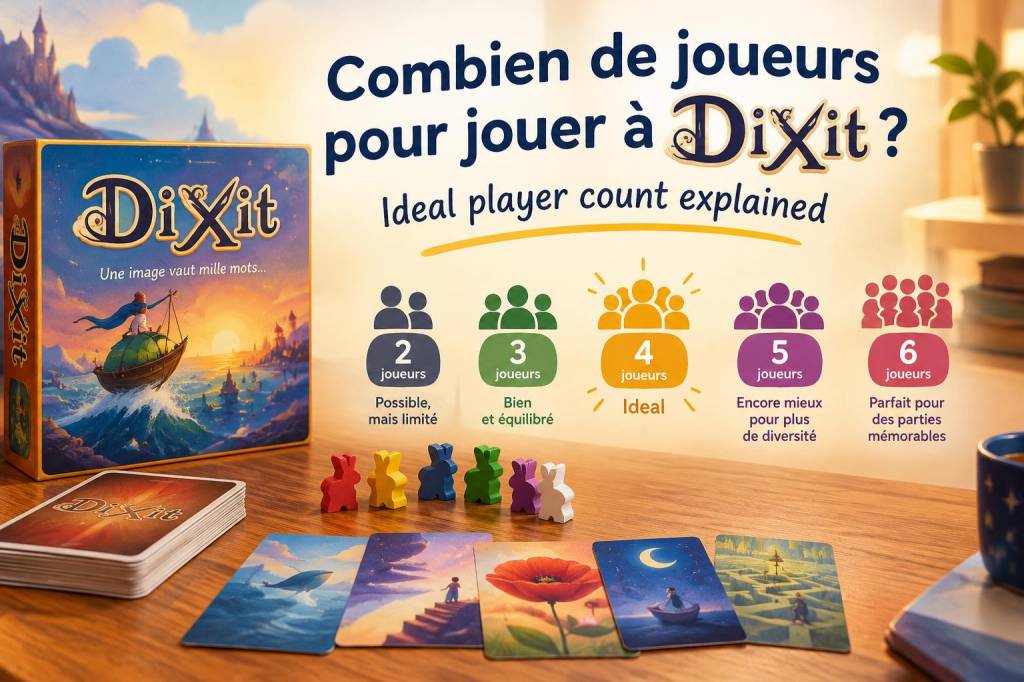
When I first started bringing Dixit to a table, I kept noticing the same question coming back: combien de joueurs pour jouer à Dixit? It sounds simple, but in practice it changes everything about the mood, the rhythm, and even the quality of the stories people create. I have seen the game feel intimate and poetic with a small group, and loud, funny, and a little chaotic with a bigger crowd. The sweet spot depends on what kind of session you want, and that is what makes this question worth exploring in depth.
Dixit is one of those rare games that can be both casual and meaningful. It works at a dinner table, at a family gathering, in a classroom, or during a relaxed evening with friends. Because it is built around imagination, association, and interpretation, player count affects more than just the length of the game. It shapes the whole experience. I want to unpack that clearly, using practical observations, official rules, and a few useful comparisons so you can decide how many players will feel right for your table.
What the official player count says
According to the official game information from Libellud, Dixit is designed for 3 to 8 players. That range is important because it tells me the game has been balanced for flexibility, not for a single fixed table size. In other words, it is not a game that only works at one “perfect” number. It is built to adapt.
The official rules also imply something else: the game needs enough people for hidden interpretation to feel interesting. With too few players, the storyteller’s clue can become too easy to trace. With too many players, the round can slow down as everyone studies the same images and tries to predict one another. So while 3 to 8 is the valid range, the experience inside that range varies a lot.
My practical answer: the ideal player count
If I had to give one clear answer, I would say 4 to 6 players is the most comfortable range for a classic Dixit session. That is where I usually see the best balance between variety, pacing, and social energy.
Here is why that range works so well for me:
- 4 players gives enough variety without overwhelming the table.
- 5 players creates strong tension because the clue can still be ambiguous, but not random.
- 6 players often produces the funniest and most creative rounds, because more viewpoints create more surprising guesses.
At 4 to 6 players, I find that each round stays meaningful. Everyone gets enough airtime to contribute, but no one is waiting too long for their turn. The game still feels lively without becoming noisy.
What changes at 3 players
Three-player Dixit is absolutely playable, and I would never call it a bad setup. Still, it feels more intimate and more predictable. There are fewer hidden interpretations on the table, which means the storyteller has less room to hide behind ambiguity. A clue that seems clever may become obvious faster than expected.
I like 3 players when I want something calm, reflective, or almost puzzle-like. It can work especially well if everyone knows one another’s style very well. In that case, the game becomes less about crowd dynamics and more about subtle reading of personalities.
Strengths at 3 players:
- Fast turns and a relaxed pace
- Clearer emotional tone
- Good for a quiet evening
Limits at 3 players:
- Less surprise
- Fewer interpretation paths
- Lower social energy overall
What changes at 4 to 6 players
This is where Dixit feels most alive to me. With 4 to 6 players, every card choice matters, but the table is still small enough for each person to keep track of the group’s style. That matters because the game is not only about fantasy images; it is also about reading how people think.
At this size, I notice three things happening:
- Clues become more layered, because the storyteller can target a wider range of minds.
- Voting becomes more interesting, because there are enough possible guesses to create uncertainty.
- Conversation after each round feels richer, because people can explain why a card made sense to them.
If I am hosting friends who enjoy creativity, I usually aim for this band first. It gives me the feeling of a shared story rather than a simple point race.
What changes at 7 to 8 players
Dixit still works at 7 or 8 players, and sometimes that larger group produces my favorite moments. More people means more interpretation, more laughter, and more unexpected card matches. The table becomes a little more theatrical.
Still, I think larger groups change the rhythm in two important ways. First, turns take longer because there are more cards on the table and more people thinking about each clue. Second, the storyteller’s clue often needs to be broader to remain fair, which can make the game feel slightly less precise.
I would choose 7 or 8 players when:
- The group enjoys social games more than competitive ones
- People are comfortable waiting a bit longer between turns
- The goal is laughter, conversation, and shared imagination
For a lively family night or a mixed-age gathering, 7 or 8 can be great. For a small, focused game night, it may feel a little stretched.
Player count and pacing in real numbers
One reason I like talking about Dixit in practical terms is that it becomes easier to plan a session. The game’s duration is usually listed around 30 minutes, but that number can shift depending on group size and how talkative the table is. In my experience, the difference can be noticeable.
| Player count | Typical feel | Approximate pace | My impression |
|---|---|---|---|
| 3 players | Quiet and focused | Very fast | Good for a calm session |
| 4 players | Balanced and smooth | Fast to moderate | One of my favorite sizes |
| 5 players | Creative and lively | Moderate | Excellent balance |
| 6 players | Social and expressive | Moderate | Strong sweet spot |
| 7 to 8 players | Big and energetic | Slower | Best for loud, relaxed groups |
If I am planning an evening with limited time, I would rather play with 4 or 5 players than stretch to 8. The game still feels rich, but I avoid the long waits that can flatten the energy.
Why group personality matters as much as group size
One thing I have learned is that player count is only part of the story. Two groups of five can feel totally different. A quiet, analytical group may create elegant clues and careful voting. A playful group may turn every round into a comedy set. Dixit is unusually sensitive to social tone.
That is why I think the best player count depends on the personality of the table:
- Creative groups usually thrive with 4 to 6 players
- Families with mixed ages often enjoy 5 to 8 players
- Small, thoughtful groups may prefer 3 to 4 players
- Large casual groups can handle 7 or 8 players if they enjoy waiting and chatting
The same number can feel perfect in one room and awkward in another. I think that is part of Dixit’s charm. It adapts to mood more than many games do.
What external sources confirm
When I compare sources, a consistent picture appears. Libellud lists 3 to 8 players, which is the clearest official range. BoardGameGeek also reflects this range and highlights the game’s flexible social nature. Reviews from sites like Dicebreaker and Tabletop Gaming repeatedly emphasize that the experience becomes strongest when the table is engaged, imaginative, and comfortable with open-ended interpretation.
That matches what I have seen in real life. The best sessions are not only about using the right number of seats. They depend on whether people are willing to read pictures differently, defend their guesses, and enjoy not knowing exactly what someone else means.
Useful references I trust for this topic include:
- Libellud official product page and rules materials
- BoardGameGeek community listing and player feedback
- Dicebreaker coverage of family and party board games
- Tabletop Gaming reviews and session impressions
My recommendation for different situations
If you want a quick recommendation from me, I would use this simple rule:
- 3 players for a calm, intimate game
- 4 players for a strong all-round experience
- 5 to 6 players for my favorite balance of energy and clarity
- 7 to 8 players for a bigger, louder, more social session
And if someone asks me again about combien de joueurs pour jouer à Dixit, I would answer that 4 to 6 is where I personally feel the game shines most often, even though the official range is broader. That answer is practical, but it is also flexible enough to fit many kinds of tables.
Small setup choices that matter more than people expect
Player count is not the only thing that shapes a good session. I have also noticed that a few small choices make a big difference:
- Seat everyone comfortably so cards are easy to see
- Keep the table quiet during clue selection so players can think freely
- Encourage playful clues instead of overly literal ones
- Avoid rushing votes because discussion is part of the charm
- Choose a group that likes interpretation more than pure strategy
Those details matter because Dixit is not really about “solving” the game in a strict sense. It is about creating a shared atmosphere where pictures become stories and stories become guesses.
When I would avoid certain group sizes
I would not avoid any legal player count entirely, but I do think some situations are better than others. If the group is very competitive, very impatient, or not interested in abstract imagery, then a bigger table can become tiring. In that case, I would rather trim the group down to 4 or 5 players.
Likewise, if the session is meant to be quiet and reflective, I would not force 7 or 8 people into the room just because the box allows it. The game is adaptable, but the social energy has to match the table size.
For me, that is the real answer behind player count: not “what is allowed,” but “what feels alive.”