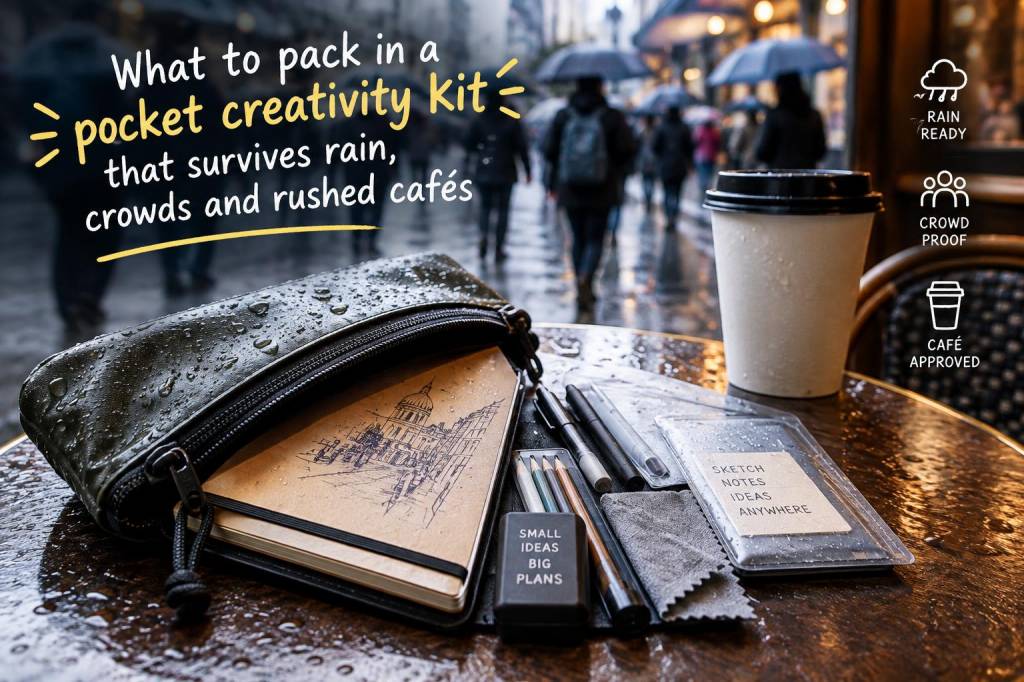
I keep a tiny "pocket creativity kit" with me most of the time. It’s the sort of thing I reach for when a rainstorm cuts a walk short and I duck into a café, when a queue becomes a quiet moment of thought, or when a crowded gallery makes sitting still on a bench the best way to notice something new. Over the years I’ve refined what goes into that little pouch so it survives rain, crowds and rushed cafés — without taking up much room or drawing attention.
Below I’ll walk you through what I pack, why each item matters, and a few practical tips for making sure the kit stays useful even when conditions are less than perfect. This is the version that lives in my day bag, folded coat pocket or the glovebox of my car — light, discrete and ready.
What I always pack
- Tiny notebook — I use a pocket Moleskine Cahier or a Field Notes-sized lined/sketch combo. It’s durable, takes ink well and fits any pocket. I prefer 48–64 pages so it doesn't become a heavy brick.
- Reliable pen — My go-to is a Pilot Hi-Tec-C (0.3) for fine lines and quick notes, and a Lamy Safari fountain pen with waterproof ink (Noodler’s or Platinum Carbon diluted) when I want something more tactile. The Hi-Tec-C is discreet and crowds-friendly.
- Mini watercolor travel set — A tiny pan set (like Kuretake Gansai Pocket or Sakura Koi Pocket) plus a water brush. The water brush is gold in cafes and rainy benches because you don’t need a jar of water.
- Mechanical pencil — For quick sketches and layout. I carry a 0.5mm with a soft HB refill and a small eraser cap.
- Folded plastic sleeve (zip-lock or reusable silicone bag) — Waterproofing for the whole kit. When the rain starts, I slide everything inside. It’s cheap insurance.
- Micro-fibre cloth — Wipes away rain, coffee splashes and keeps pens clean. Small and multi-functional.
- Mini ruler/stencil card — Metal or sturdy plastic, 10–12cm. Useful for quick frames, lettering guides or to steady a hand on shaky public transport.
- Washi tape or tiny binder clips — For securing pages to tables in breezy outdoor spots, or taping things down without damaging surfaces.
- Waterproof sticky notes or index tabs — For capturing a fleeting thought and sticking it immediately to the page.
- Small set of coloured pencils — I keep three or four sharpened colours (warm, cool, neutral) for quick accents when watercolour isn’t appropriate in a crowded cafe.
Why these choices work in rain, crowds and rushed cafés
- Portability — Everything fits a palm-sized pouch. That means I can tuck it away during a conversation or hold it in one hand while I order coffee.
- Minimal setup — No jerry-rigging. A water brush and pocket palette mean I don’t need cups, jars or special surfaces — perfect when the barista is waiting for the table.
- Discretion — Fine liners and pencil are low-key; they don’t attract long conversations (handy when you want to focus) and are acceptable in most public spaces.
- Quick dry and waterproof options — Using waterproof ink or fast-drying pens prevents smudges in rain or when you close your notebook in a hurry.
How I use the kit in different situations
Here are a few real-life scenarios and the pieces I reach for:
- Downpour and a quick café stop: I put the kit in its plastic sleeve before I step inside. At the table I open the notebook, sketch with the mechanical pencil for structure, lock in key lines with the Hi-Tec-C, then wash over colour with the water brush. The sleeve keeps everything dry on the walk home.
- Crowded gallery benches: I use the ruler to frame a quick composition, then mark tones with the coloured pencils. If someone sits close, I close the notebook and hide the brush — it makes the interaction feel less intrusive.
- Rushed café with a 10-minute wait: Bullet list of ideas with the waterproof sticky note, capture a tiny thumbnail sketch, and add a single swipe of watercolour for mood. Done. The Hi-Tec-C and small notebook are perfect for this tempo.
Packing and organisation tips
- Use a slim pouch with compartments — Mine is a zipped canvas pouch with one inner sleeve. Pens go in the sleeve so they don’t rattle into the notebook and smear.
- Layer for protection — Notebook, then cloth, then pens. The micro-fibre cloth acts as a buffer; it keeps wet brushes away from the paper when not in use.
- Rotate supplies regularly — I sharpen the small pencils and test the water brush once a month. Dried-up brushes or broken pen tips are the fast track to frustration.
- Keep duplicates of critical items — I carry one spare ink pen and a backup small pen in another bag. Running out mid-idea feels worse than a rainy commute.
Optional items depending on your style
- Compact phone tripod or clip — For quick time-lapse or reference photos when a sketch needs a little more attention later.
- Tiny glue stick or tape runner — If you like pasting ephemera into your notebook on the spot.
- Mini stapler or sewing kit — Handy when you want to turn a few sheets into a mini zine at a park bench.
- Smartphone with a photo of your colour swatches — I keep a reference photo of my favourite watercolour mixes so I can match tones without carrying more gear.
Quick-reference table: pocket kit at a glance
| Essential | Moleskine/Field Notes, Pilot Hi-Tec-C, mechanical pencil, water brush, pocket pan set, plastic sleeve |
| Extras | Washi tape, micro-fibre cloth, mini ruler, coloured pencils, waterproof sticky notes |
| Optional | Phone clip, mini stapler, tiny glue, spare pen |
Most of all, the point of a pocket kit isn’t to be perfect — it’s to be ready. A small set of trusted tools, packed sensibly, will help you turn stolen moments into something you can build on later. When the weather changes, a line of people becomes a lull to think, or the café music makes you restless, reach for the pouch. Even if you only have three minutes, a single stroke of ink or a quick colour wash can change the rest of your day.