Creativity

How to create a 10-minute breakfast routine that reliably boosts your creativity before work

How to create a 10-minute breakfast routine that reliably boosts your creativity before work

I used to think a creative morning required hours: a long walk, a notebook full of stream-of-consciousness, a fancy journaling ritual. What changed for me was the reality of weekday life — a full inbox, commuting, and the small, stubborn fact that my best ideas often come in the first hour after waking. So I started experimenting: what if I could reliably nudge my brain into a creative mode in just 10 minutes while making breakfast? The result is a compact routine I use before work that primes curiosity, loosens perfectionism, and leaves me with a small, satisfying creative win every day.

Why a 10-minute routine works for creative priming

Creativity isn't only about long stretches of uninterrupted time. It's also about states of mind: curiosity, relaxed attention, and permission to play. A short, intentionally designed routine can:

  • Activate the default mode network (the part of the brain associated with imagination) through gentle, non-goal-oriented tasks.
  • Lower the stakes so experimentation feels safe — a tiny success is still momentum.
  • Fuse a simple physical routine (making breakfast) with a cognitive one (a creative prompt), so the habit is easy to repeat.
  • I model my breakfast routine to support those cognitive shifts. It’s practical: food that’s quick and nourishing. It’s sensory: textures, smells, and colors that wake the senses. And it includes a tiny creative prompt to invite play.

    What I keep on hand (minimal pantry and tools)

    You don’t need a stocked pantry to try this. Here’s what I find most useful in a small, consistent setup:

  • Oats (quick or rolled), eggs, yogurt or kefir, a banana or seasonal fruit.
  • A jar of mixed nuts or seeds, honey or maple syrup, and a spice like cinnamon.
  • A kettle, a small saucepan or a microwave (if you’re rushed), a bowl and a spoon.
  • A small notebook or index cards and a pen — the most important tool for the creative part.
  • The 10-minute routine — step by step

    Timing is approximate. The key is to move with intention rather than hurry. I set a simple timer for 10 minutes if I need accountability.

  • Minute 0–1: Wake, hydrate, set a micro-intention. I pour a glass of water or a cup of tea and say aloud one micro-intention: “Notice one curiosity.” Saying it makes it real.
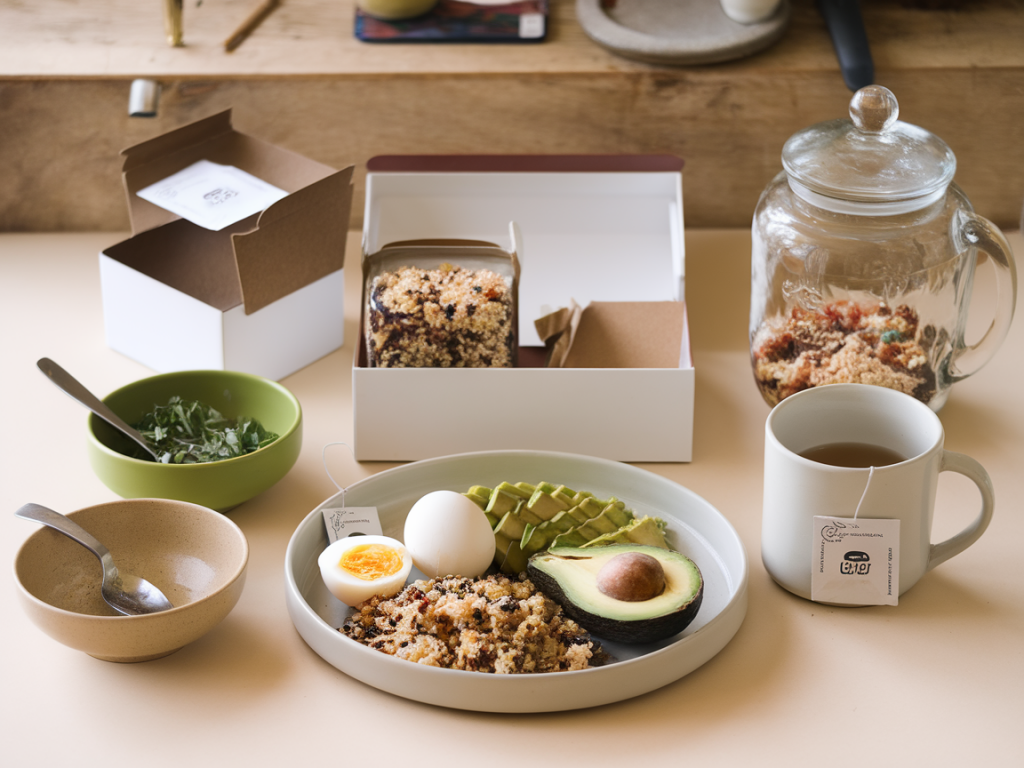
  • Minute 1–4: Make a quick, sensory breakfast. My go-to is a “creative porridge”: 3 minutes in the microwave for rolled oats with milk or water, stir in a mashed banana, a pinch of cinnamon, and a tablespoon of nuts or seeds. If I have eggs, I might soft-boil one while the kettle heats (a 6-minute egg works if I start a little earlier). The act of cooking grounds me and wakes up my senses — the steam, the sweetness of fruit, the crunch of seeds.
  • Minute 4–8: The creative prompt. With breakfast ready, I sit in a place with a small patch of daylight if possible. I keep a tiny notebook or an index card next to me and pick one prompt from a rotating list I made. I give myself three minutes to write freely. Prompts are deliberately small and playful (examples below). No editing, no judgment — just ink.
  • Minute 8–10: Choose one tiny next step. From the freewriting I pick one line, image, or idea that intrigues me and decide on a micro-action. It could be: save the line as an email subject for later, sketch a thumbnail idea in my notebook, take a photo to expand on during lunch, or drop a one-sentence note into a “future ideas” folder. The goal is to create an exit ramp for the idea, so it doesn't evaporate when I switch to work.
  • Sample prompts I use (rotate these)

    Rotate a few prompts so the routine feels fresh. Keep them short — they should invite rather than overwhelm.

  • “Describe the breakfast in one surprising adjective and one small story.”
  • “If this morning were a color, what would it be? Why?”
  • “Write a two-sentence micro-fiction that begins with: ‘I found it in my pocket…’”
  • “List three odd uses for the spoon you’re holding.”
  • “Note one tiny curiosity you want to explore this week.”
  • Small recipes that fit the routine

    Here are two breakfasts I rotate depending on season and how much patience I have:

    3-minute creative porridgeRolled oats + milk or water + mashed banana + pinch cinnamon + 1 tbsp seeds/nuts. Microwave 2.5–3 min, stir, top.
    Simple yogurt bowlPlain yogurt or kefir + fruit + granola or seeds + drizzle honey. No heat required, assembled in 1–2 minutes.

    How to keep it sustainable

    Short routines succeed when they’re flexible and low-friction. Here’s what helps me stick with this practice:

  • Prepare the night before: lay out the bowl, spoon, and notebook so the mental barrier in the morning is smaller.
  • Make prompts easily reachable: a small stack of index cards by the kettle or a note in my phone’s widget.
  • Lower the pressure: the aim is not to produce a masterpiece, it’s to prime my brain. If I miss a day, I notice and move on.
  • What to expect after a few weeks

    The routine doesn’t guarantee a headline idea each morning, but it reliably shifts my mental baseline. I notice:

  • More playful connections during work tasks. Small analogies and choices appear more easily.
  • Less resistance to starting creative work later — that tiny win at breakfast reduces inertia.
  • A growing habit library: over time the index cards accumulate interesting fragments worth revisiting.
  • When it doesn’t work (and what I change)

    Some mornings the routine feels slow, or my body wants another cup of coffee and sleep. When that happens I scale it down: 5 minutes of mindful sipping and a single prompt (often “one curiosity today”). Other times I swap the written prompt for a quick sketch on my phone. The point is the scaffold, not the exact shape.

    If you want to try this tomorrow, prepare one breakfast component tonight (a jar of overnight oats, a peeled banana, or a boiled egg). Keep one prompt ready. Spend 10 minutes and treat it like an experiment — observe what changes in your mood and ideas over a week, and adapt it to make it yours.

    On Blogslife Co (https://www.blogslife.co.uk) I share many small routines like this one — practical, flexible, and designed for real life. If you try the 10-minute breakfast routine, I’d love to hear which prompt sparked something for you. Drop a note in the comments or send a quick message through the contact links — I read them all.

    You should also check the following news:

    How to host a three-course tasting night from supermarket finds using a slow cooker and simple plating tricks
    Food & Drink

    How to host a three-course tasting night from supermarket finds using a slow cooker and simple plating tricks

    I love the idea of a tasting night: small plates, a relaxed vibe, and the chance to savour a few...

    Mar 21 Read more...
    How to design a two-week personal growth experiment around tiny habits and a free habit tracker
    Personal Growth

    How to design a two-week personal growth experiment around tiny habits and a free habit tracker

    I love the idea of testing small changes with a timebox: two weeks feels short enough to commit to...

    Feb 03 Read more...