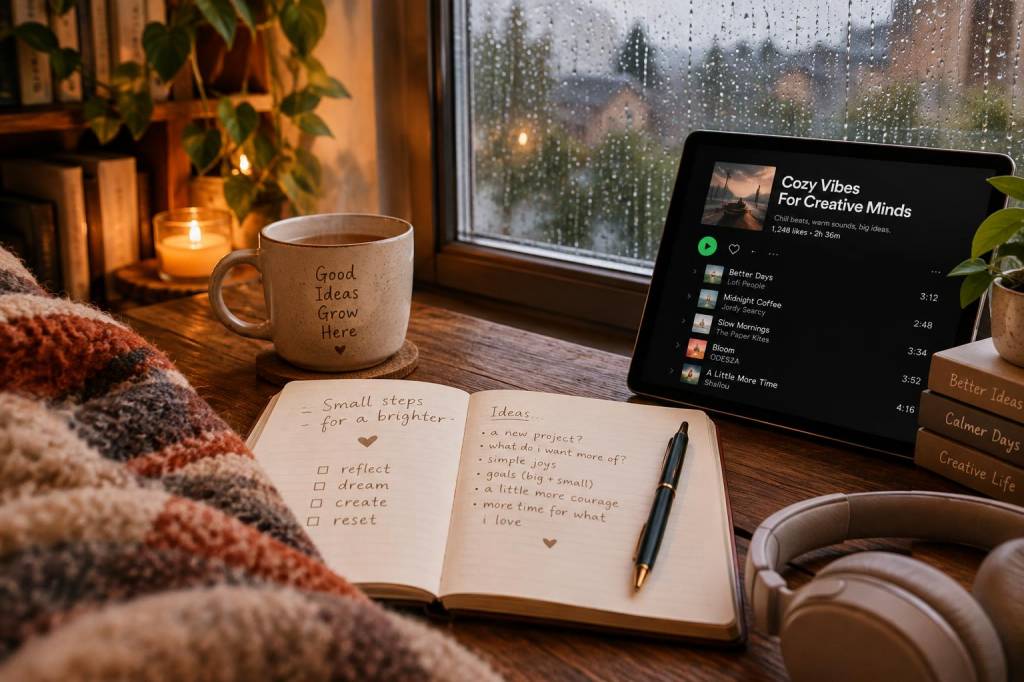
Rainy afternoons used to make me restless. I would stare at the window, feel my energy drop, and start scrolling through my phone as if motion on a screen could replace motion in my own life. Over time, I learned that a grey, drizzly afternoon can become one of the most useful pockets of the week. It is not wasted time. It is a small opening. When I give myself one notebook and a playlist, I can turn that dull stretch of weather into a cozy creative reset that feels gentle, simple, and surprisingly productive.
What I love most about this ritual is that it does not ask for much. I do not need a perfect desk, a new notebook collection, or a fully planned project. I only need something to write on, something to listen to, and a willingness to let my mind slow down. That combination works because it removes pressure. A rainy afternoon already creates a softer atmosphere, and I try to match that mood rather than fight it. Once I stop treating the day as something to escape, I can use it as a container for ideas.
Why rain changes my creative rhythm
There is something about rain that lowers the volume of everything else. Street noise fades. Light becomes gentler. Even ordinary rooms can feel more intimate. I notice that my thoughts become less scattered when I lean into that atmosphere. Instead of trying to power through a complicated task, I choose creative work that benefits from reflection: journaling, idea mapping, rough sketches, lists of possibilities, or a page of honest notes about what I actually want to make next.
I think this works because creativity rarely arrives on command. It often shows up after a bit of mental unclenching. Rain gives me a believable excuse to slow down, and I have learned that slowing down is not laziness. It is often preparation. When I sit with a notebook while rain taps at the windows, I am more likely to notice the small thoughts that would otherwise pass by unnoticed. A half-formed idea can become a sentence. A sentence can become a plan. A plan can become a project I am genuinely excited to continue tomorrow.
My notebook reset starts with removing friction
I keep one notebook nearby for days like this, and I try to make it feel easy to open. I do not reserve it for perfect notes. It is not a place for polished writing only. It holds messy thoughts, quick sketches, post-it scraps, and half-finished lists. That freedom matters because a creative reset can fail if I treat the notebook like a test. I want it to feel welcoming, not intimidating.
Before I begin, I usually clear a small surface, make a drink, and place my notebook where I can see it. Sometimes I choose tea, sometimes coffee, and sometimes just sparkling water with lemon if I want a fresher feeling. That tiny bit of preparation sends a message to my brain: this afternoon is for noticing, not forcing. I also keep a pen I genuinely enjoy using. It sounds minor, but a pen that glides easily can make me want to keep going.
Then I open to a blank page and start with one very simple prompt:
- What feels heavy right now?
- What feels interesting but unfinished?
- What would make this week feel lighter?
- What am I curious about today?
- What could I make without needing permission?
I do not answer all of them every time. I choose one and let it lead. Some days I write a page about practical life admin, because clearing mental clutter creates room for better ideas. Other days I jot down creative fragments: a phrase, a color combination, a future article concept, a meal I want to try, a photo idea, or a room I would like to reorganize. The point is not to finish anything immediately. The point is to restart the part of me that pays attention.
Why music changes everything
A playlist gives the afternoon shape. Without music, I can drift too far into distraction or end up listening to every tiny house sound at once. With music, I have a steady background that nudges me into flow. I usually choose songs that feel warm, calm, and a little cinematic. I want enough rhythm to keep my mind awake, but not so much intensity that I start performing my own productivity.
I build playlists based on mood rather than genre. For me, a good rainy-day list might include soft indie tracks, piano pieces, acoustic covers, mellow electronic songs, or older favorites that feel emotionally safe. I avoid anything too chaotic because I am not trying to energize myself into a sprint. I am trying to create a soft landing place for ideas.
Sometimes I use music in a more deliberate way. I will start with slower songs while I write freely, then switch to slightly more upbeat tracks when I want to sort my notes into categories. If I am sketching or planning, I might use instrumentals only. Lyrics can be wonderful, but they can also pull my attention away when I need focus. Over time, I have learned that music is not just background noise for me. It is a setting. It tells my mind what kind of afternoon this is.
What I actually do during a cozy creative reset
I keep my routine flexible, but there is a rough shape I return to because it works well for me. It feels like a conversation with myself rather than a productivity drill.
- I write a short brain dump of whatever is present.
- I circle one idea that feels worth exploring.
- I make a page of connections, questions, or related thoughts.
- I note anything I want to revisit later this week.
- I choose one tiny next action, if one exists.
That last step is important. A creative reset should leave me lighter, not overloaded. If an idea grows too big for one afternoon, I break it into the smallest next move. Maybe that means naming a project, saving a reference, drafting an outline, or taking a photo of something I want to remember. Small actions keep momentum alive without draining the softness of the moment.
I also like to give myself permission to make pages that are not meant for anyone else. Some afternoons I write a private reflection about what I have been avoiding. Other afternoons I collect sensory details from the day: the smell of rain on the pavement, the sound of a kettle, the way the room changes when clouds pass across the window. These notes often become useful later. Even if they never appear in a finished project, they train me to observe more carefully.
What I put on a rainy-day page
When I feel stuck, I use specific prompts that help me move from vague mood into usable material. They are simple, but they work because they invite detail.
| Prompt | Why I use it | What it can lead to |
|---|---|---|
| What do I want more of this week? | It clarifies priorities | A more focused plan |
| What idea keeps returning? | It reveals true interest | A new project direction |
| What feels unfinished but worth returning to? | It surfaces hidden energy | A revived draft or concept |
| What would feel satisfying to complete in one hour? | It keeps the task realistic | A small win with momentum |
If I am especially tired, I write less and observe more. I might list five things I can see, four sounds I hear, three objects on my desk, two ideas I want to keep, and one thing I want to release. This kind of page is calming because it brings me back into my body and out of my overthinking. A rainy afternoon can be wonderfully grounding when I stop demanding performance from it.
Making a small ritual feel personal
The reason this reset feels meaningful to me is that it is mine. I shape it around what I actually enjoy rather than what looks impressive. I like a mug that feels good in my hands. I like a pencil case that stays open easily. I like a playlist that feels like a soft room. I like a notebook page that begins with a messy first line and then gradually becomes clearer as I keep writing.
Sometimes I add one extra detail that makes the atmosphere feel special: a candle with a subtle scent, a blanket over my knees, a lamp instead of overhead light, or a plate of something simple to nibble on. None of that is required, but small comforts can make creativity feel hospitable. When I am comfortable, I am more willing to stay with my thoughts long enough for something useful to emerge.
I also try to treat the session as a reset rather than a rescue mission. A rainy afternoon does not need to fix my entire week. It only needs to give me a better next step. That mindset helps me stay generous with myself. If I leave with one clear idea, one calmer thought, and one page of honest writing, I count that as a strong afternoon.
What usually changes afterward
After I finish, I nearly always feel a little more settled. My head is less crowded. My next task feels easier to name. Sometimes I end up with material I can reuse in an article, a personal project, or a plan for the following day. Sometimes I simply feel more like myself again. That counts too.
I have learned that a cozy creative reset is not really about rain, a notebook, or a playlist on their own. It is about creating a small environment where my attention can return to me. It is about listening for the ideas that arrive when life gets quieter. It is about remembering that creative energy does not always need a big stage. Sometimes it just needs an afternoon, a page, and a song that makes the room feel warm.
When I let a rainy afternoon become a gentle invitation instead of a slow disappointment, I usually end up with more than a page of notes. I end up with a clearer sense of what I want to make, what I want to protect, and what I want to carry into the rest of the week.