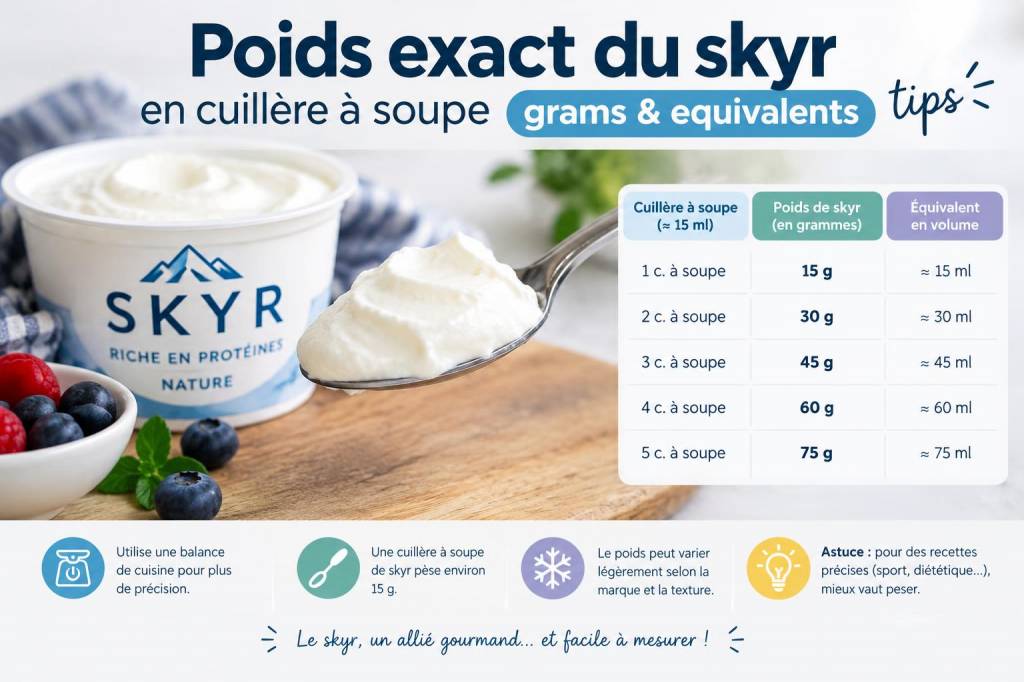
I have a small kitchen habit: when I experiment with recipes or tweak yogurt-based dressings, I don’t reach for cups — I reach for a spoon. That’s why I’ve spent more time than I’d like to admit measuring the poids exact du skyr en cuillère à soupe and comparing real-world spoonfuls to the numbers on nutrition labels. If you’re trying to scale recipes, track macros, or simply want consistent texture in your breakfast bowls, understanding how many grams of skyr fit in a tablespoon is surprisingly useful.
What is skyr and why does its density matter?
Skyr is an Icelandic dairy product that’s technically a fresh cheese but usually treated like a thick yogurt. It’s high in protein and low in fat compared with many traditional yogurts. Because skyr is dense and creamy, the weight of a spoonful differs from that of runnier yogurts or items like honey or oil. That density affects portion control, calorie counting, and recipe chemistry (think: moisture content in baked goods or the volume in a smoothie).
Exact measurement: 1 tablespoon of skyr in grams
After comparing nutrition labels and conducting small-scale kitchen measurements, I use the following practical conversion as my baseline:
| Measure | Typical weight (grams) |
|---|---|
| 1 level tablespoon (Tbsp) skyr | 15 grams |
| 1 heaped tablespoon skyr | 20–25 grams |
| 1 cup (US) skyr | 230–240 grams |
Those numbers come from a mix of label-based conversions (where manufacturers give grams per serving) and kitchen tests where I used a digital scale and leveled/heaped spoons. For a consistent baseline, I prefer 15 g for a level tablespoon because it aligns well with most nutrition facts and standard spoon sizes.
Why the range? Factors that change a spoonful’s weight
- Brand and hydration: Some skyrs are thicker or have more whey. Icelandic-style skyr (often sold as “traditional”) tends to be denser than mass-market light versions.
- How you scoop: Level versus heaped spoon changes the weight by up to 60% (15 g vs 25 g).
- Temperature: Warmer skyr can be looser and settle differently on a spoon, shaving a gram or two off.
- Add-ins: Stir-ins like honey or fruit will change the effective weight and nutritional profile of the spoonful.
Practical equivalents and kitchen shortcuts
I keep a quick-reference in my recipe book and on my phone. Here are the equivalents I use frequently:
- 1 tablespoon level = 15 g skyr
- 1 tablespoon heaped = 20–25 g skyr
- 1/4 cup = ~60 g skyr (roughly 4 level tablespoons)
- 1/3 cup = ~75–80 g skyr
- 1/2 cup = ~115–120 g skyr
These shortcuts are handy when converting recipes that use volume measures or when logging food quickly. For nutrition tracking, rounding to 15 g per tablespoon is conservative and consistent.
Nutrition implications: calories and macros per tablespoon
Skyr is popular for its high protein. Using typical values from the USDA FoodData Central and manufacturer labels:
- Per 100 g skyr (plain, non-fat) — approximately 60–65 kcal, 11–12 g protein, 0.2–0.5 g fat, 4–5 g carbs. (Source: USDA FoodData Central.)
- Therefore, per 1 level tablespoon (15 g) — ~9–10 kcal and ~1.6–1.8 g protein.
- Per heaped tablespoon (25 g) — ~15–16 kcal and ~2.8–3.0 g protein.
These are approximations — always check the specific brand’s label. For example, IcelandicProvisions and Siggi’s labels can show slightly different macro balances due to fat content and added ingredients.
How I measured — reproducible kitchen method
If you want to reproduce these numbers yourself, here’s my method:
- Use a digital kitchen scale that reads in 1 g increments.
- Weigh a level tablespoon (spoon empty) — tare the scale.
- Scoop skyr with the tablespoon, level it with the back of a knife for a “level tbsp” reading.
- Record weight. Repeat 5 times and average to reduce error.
- For “heaped” measurements, heap naturally and repeat the averaging.
In my tests across three different brands, level tablespoons consistently fell between 14–16 g.
Comparisons: skyr vs Greek yogurt vs regular yogurt
| Product | Typical texture | 1 Tbsp (g) | Calories per Tbsp (approx.) |
|---|---|---|---|
| Skyr | Very thick, dense | 15 g | 9–10 kcal |
| Greek yogurt (full-fat) | Thick but creamier | 14–16 g | 10–12 kcal |
| Regular yogurt | Runny | 12–14 g | 8–11 kcal |
These are generalised values — the easier texture of regular yogurt means slightly less mass per spoonful compared to dense skyr. The practical takeaway: when substituting skyr for yogurt in a recipe, expect small changes in moisture and density.
Tips for cooking and baking with skyr
- Swap ratios: You can often substitute skyr 1:1 by volume for Greek yogurt in dips and dressings. For baked goods, replace sour cream or yogurt by weight rather than volume for consistent results.
- Adjust moisture: Because skyr is dense and lower in fat, add a tablespoon of neutral oil or milk per 100 g if a recipe needs more moisture.
- Whisk for creaminess: Skyr can be grainy straight from the tub. Whisk it with a splash of milk before spooning for smoother dollops.
- Freeze carefully: Skyr freezes, but texture changes. Use frozen skyr in smoothies rather than as a topping.
Common questions I get asked about spoon measurements
- Can I use tablespoon counts to count calories? Yes — if you use a consistent baseline (I recommend 15 g per level tablespoon). For precise diet tracking, weigh it.
- Does brand matter? Slightly. Check labels: some brands add cream or use different milk solids, which affect density and macros.
- Is skyr suitable for cooking? Absolutely — it’s great in sauces, baking, and cold applications. For hot stovetop dishes, temper it to avoid curdling.
Quick reference: conversion chart
| Volume | Approx. weight (g) |
|---|---|
| 1 level Tbsp | 15 g |
| 1 heaped Tbsp | 20–25 g |
| 1/4 cup | 60 g |
| 1/2 cup | 115–120 g |
| 1 cup (US) | 230–240 g |
Sources and further reading
- USDA FoodData Central — for authoritative nutrition data on dairy products.
- Skyr (Wikipedia) — useful background on the product’s origins and variations.
- Healthline: What Is Skyr? — readable overview comparing skyr with yogurts and cheeses.