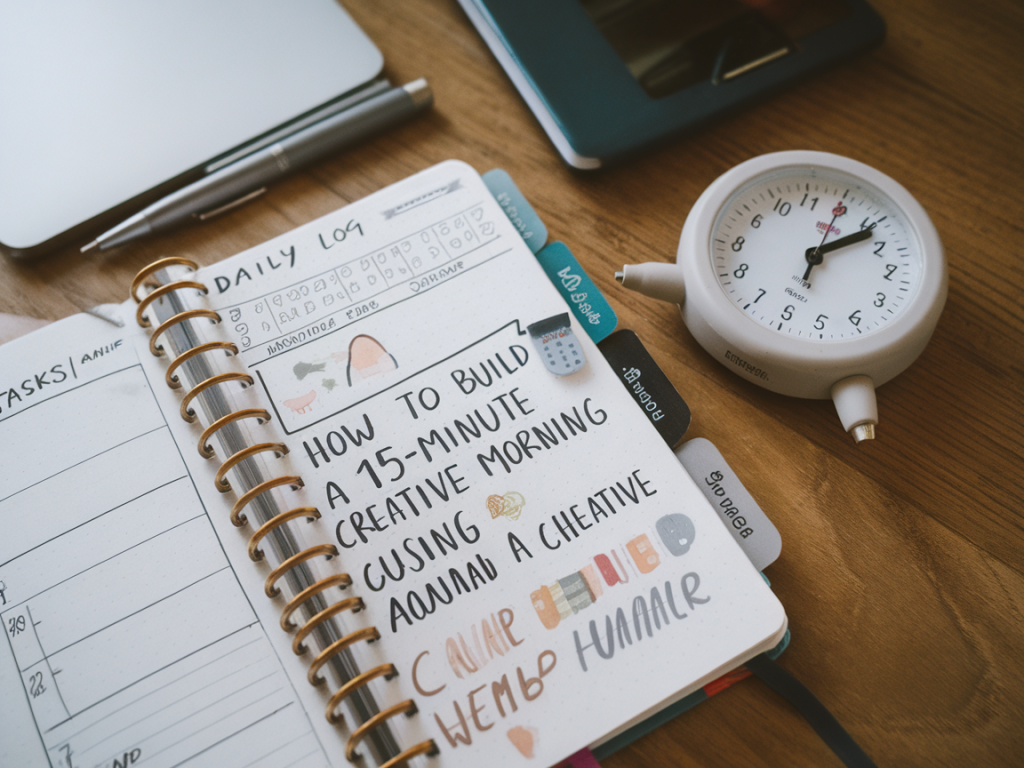
I’ve been experimenting with tiny creative rituals for years, and one of my favourites is a 15-minute morning session that uses nothing fancier than a bullet notebook and a cheap timer. It’s simple, portable, and—surprisingly—powerful. When you only have a quarter of an hour, you’re forced to focus on something small and meaningful. Over time those tiny sessions add up into projects, ideas, and a steadier creative muscle.
Why 15 minutes?
Fifteen minutes is short enough to remove the “I don’t have time” excuse, and long enough to do something satisfying. It’s also a psychologically friendly duration: your brain knows there’s an end in sight, so it’s easier to start. I use this format when I’m travelling, between meetings, or on busy days when I still want to move a creative project forward.
What you’ll need
Keep it minimal. The two items that matter are:
A bullet notebook (any dotted or lined notebook will do) — I like a small A5 notebook so it feels portable and not intimidating.A cheap timer — a basic kitchen timer, a small digital timer from Amazon, or a phone timer set to 15 minutes. I sometimes use a mechanical wind-up timer because the physical twist feels ritualistic.If you want extras: a pen you enjoy using (Pilot G2, Uni-ball Jetstream, or a fountain pen if you’re fancy), a coloured highlighter, and a sticky note for quick capture. But the core practice works with just notebook + timer.
How I structure the 15 minutes
My sessions are short so I aim for clarity. Here’s the structure I use most mornings:
Minute 0–2: Quick set-up and intention — Open your bullet notebook to a fresh spread, write the date, and jot a tiny intention or goal for the 15 minutes.Minute 2–12: Focused creative time — Work on the single creative task you chose. No distractions, no switching tasks.Minute 12–15: Capture and reflect — Write a one-line note about what happened: a next step, an idea to revisit, or simply a judgement-free observation.This structure keeps things simple. The initial two minutes banish indecision and the final three minutes turn fleeting ideas into actionable notes that your future self can use.
Using a bullet notebook efficiently
The beauty of a bullet notebook is flexibility. I use rapid logging and a few micro-layouts that make these short sessions productive.
Daily header: Write the date and a one-line theme (e.g., “5-min poem” or “Sketch idea: tea bottle”).Rapid log: Bullet tasks with short signifiers — • for tasks, — for notes, * for inspiration. Use an asterisk (*) to highlight anything you want to return to.Progress bar: Draw a tiny 10-block progress bar and fill in blocks as you go. It’s satisfying and motivating for tiny sessions.Example layout for a 15-minute creative morning:
| Date | 2026-09-01 |
| Theme | Micro-essay on morning tea |
| Task | • Write 150 words |
| Notes | — Start with sensory detail: steam, mug warmth |
| Next | * Expand into full post idea |
Choosing a creative task
Because time is limited, choose a single, specific task. Here are ideas that fit neatly into 15 minutes:
Write the first draft of a micro-essay (100–200 words).Sketch a simple scene or object—no perfection, just lines.List 10 headline ideas for an article or post.Brainstorm five small project prompts (each one-liners you could use later).Write a short poem or haiku.Mind-map a topic for 10 minutes, leaving 5 minutes to tidy notes.The clearer your task, the less time you waste deciding what to do. If you struggle to pick, keep a page in your bullet notebook titled “15-minute ideas” as a ready-made queue.
Timer tips
The timer is there for more than just measuring time—it’s a psychological boundary. A few practical tips:
If you get distracted by your phone, use a physical timer. Mechanical or digital kitchen timers are perfectly fine and cheap—look for a simple egg timer or a small digital countdown on Amazon under £10.If you prefer your phone, use a dedicated interval timer app (Interval Timer, Seconds) and name the timer “Create.” Having a visible label helps prime your brain.Set the timer and physically move away from distractions. Close tabs, put your phone face down, or wear noise-cancelling headphones if that helps.Handling resistance
Even when I know 15 minutes will be enjoyable, I sometimes resist. Here are a few small tricks that work for me:
Make starting trivial: say to yourself, “I’ll do one minute.” Often, once the minute is up, I keep going.Use a ritual to cue the session—a mug of tea, a particular playlist, or the act of twisting the timer. Rituals lower the activation energy.Allow imperfection. The aim isn’t a masterpiece; it’s to build momentum. I tell myself this is research rather than a performance.Ways to scale or vary the practice
After a few weeks you’ll know what works. Here are variations to keep the practice fresh:
Stack days: Repeat the 15-minute session three mornings in a row on the same project for a 45-minute creative block across days.Themed weeks: One week could be sketching, the next could be micro-essays, another week could be idea generation for social posts.Accountability buddy: Share a photo of your bullet page at the end of the session with a friend. It’s a gentle form of accountability.How I track progress
I use my bullet notebook index to keep track of sessions. Each time I do a 15-minute session, I add a quick entry in my index with the date and a one-line summary. Over time that index becomes a tiny log of creative output—proof that small, consistent efforts accumulate.
Sample prompt list to get started
Here are ten quick prompts you can drop into your notebook for tomorrow’s 15-minute session:
Describe your morning routine in five sensory details.Sketch the view from your kitchen window.Write a 150-word scene that begins with “I almost forgot…”List ten things you could photograph this week.Write three opening lines for an essay about curiosity.Invent a simple ritual for taking a break and sketch it.Brainstorm five ways to repurpose an old jar.Create a one-paragraph character sketch of someone who loves tea.Mental map: “What inspires me” and draw connections.Write a tiny dialogue (6–8 lines) between two objects in your kitchen.Pick one, set your timer, and you’ll be surprised how much you can do in a quarter of an hour. The combination of a bullet notebook and a cheap timer makes this practice accessible, repeatable, and—best of all—gentle enough to keep coming back to.