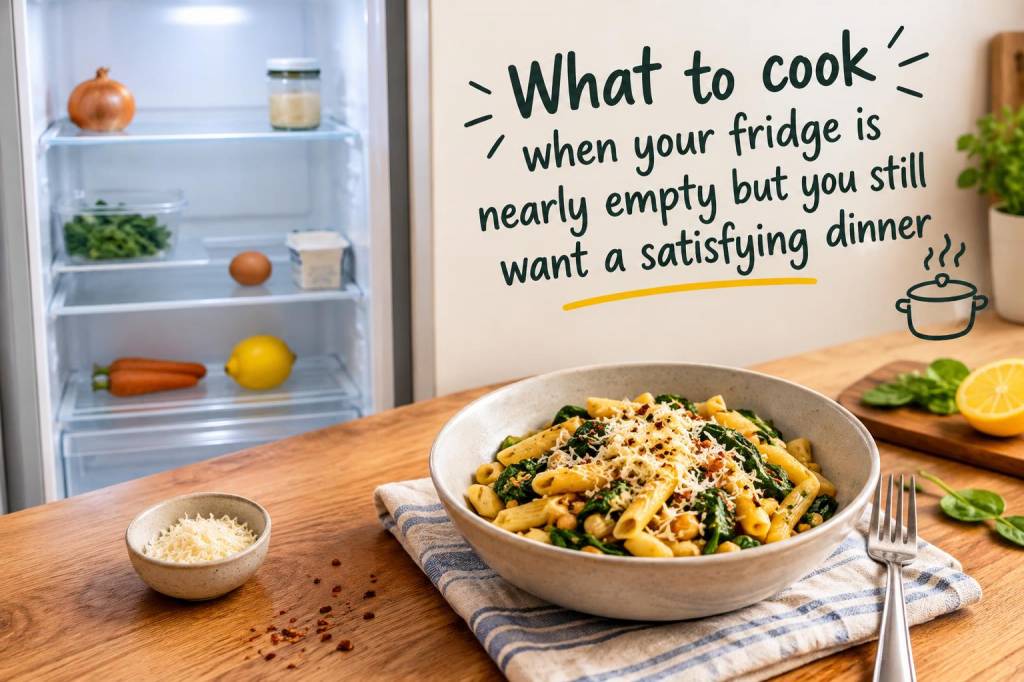
I have learned that a nearly empty fridge is not a cooking disaster. It is a very small creative challenge, and I often find that it leads to some of my most satisfying dinners. When I open the door and see a lone carrot, half a lemon, a spoonful of yogurt, a bit of cheese, one tired onion, and a few random leftovers, I stop thinking in terms of missing ingredients and start thinking in terms of useful building blocks. A good dinner does not need a crowded shelf. It needs enough salt, something filling, something with texture, and one flavor that makes everything feel alive.
My approach is simple: I look at what is already there, decide which ingredient deserves to be saved, and then build around it. That small shift in thinking changes everything. Instead of asking, “What can I cook with almost nothing?” I ask, “What can I make feel complete?” That question usually leads me to a bowl, a skillet, a toast, a pasta, a soup, or a grain dish that feels more generous than the fridge inventory would suggest.
Start with a base that can carry everything
When supplies are low, I like to begin with a base that can absorb flavor and fill me up. Rice, pasta, potatoes, bread, oats, couscous, or canned beans are usually enough to create a real meal. If I have a packet of noodles, I know I am already halfway there. If I have bread, I can make toast, a tartine, a melt, or a quick bruschetta-style dinner. If I have potatoes, I can roast, mash, pan-fry, or simmer them into something comforting.
I pay attention to texture as much as flavor. A plain bowl of rice feels much more satisfying when it has something crisp on top, something creamy on the side, and something sharp to brighten it. A pasta dish feels richer when it has garlic, oil, cheese, herbs, or even a spoonful of tomato paste loosened with a little water. A potato dinner becomes much more interesting when I add mustard, yogurt, onions, or a crunchy topping made from breadcrumbs and oil.
My pantry is rarely empty, even when my fridge is. That matters. I keep a few reliable items around because they turn scraps into dinner:
- Olive oil
- Garlic or garlic powder
- Onions
- Canned tomatoes
- Beans or lentils
- Rice or pasta
- Broth cubes or stock powder
- Cheese
- Mustard, soy sauce, or vinegar
- Herbs and chili flakes
Use leftovers as ingredients, not afterthoughts
Leftovers are often the hidden answer to an almost empty fridge. I used to think of them as separate from dinner, as if they were unfinished business from another day. Now I treat them as ingredients with a second life. Half a roasted vegetable tray becomes a frittata filling. A few spoonfuls of cooked grains become a fried rice base. A lonely portion of chicken can be sliced thin and folded into noodles, soup, or a wrap. Even a small amount of salad can be revived with something warm and savory.
One of my favorite habits is to taste leftovers before deciding what they need. Cold rice often wants a little oil and heat. Roasted vegetables may only need a splash of vinegar or a drizzle of yogurt. Cooked greens can become much more appealing with garlic and lemon. If a leftover seems bland, I treat it like a blank canvas rather than a failed meal.
I also like to think in terms of mixing temperatures. A hot base with a cool topping feels much more complete than a dish that is all one note. For example, warm beans with cold chopped tomato and yogurt can feel fresh and filling. Hot pasta with a handful of raw herbs and a bit of grated cheese can feel restaurant-worthy even if I made it from scraps. That contrast helps a simple dinner feel intentional.
Build flavor in layers, even with very little
When ingredients are limited, seasoning becomes everything. I have made delicious dinners from very little by focusing on layers of flavor instead of quantity. First I cook onion or garlic if I have it. Then I add salt and pepper early, not just at the end. Next I use one bright note, like lemon juice, vinegar, mustard, or a spoonful of pickle brine. After that, I add something rich, such as oil, butter, cheese, or yogurt. Finally, I finish with herbs, chili, or toasted crumbs if I have them.
That process works because each layer does a different job. Aromatics create depth. Acid wakes everything up. Fat makes food feel satisfying. Heat adds energy. Fresh herbs make a dish seem brighter than it really is. Even a can of beans can become dinner if I treat it carefully. I simmer them with garlic, onion, cumin, and a little tomato, then finish with parsley or scallions and serve them over toast or rice.
I have also learned not to underestimate a little sweetness. A tiny amount of honey, sugar, or caramelized onion can balance a dish that tastes flat. If my tomatoes are sharp, I soften them. If my vegetables are bitter, I add richness. If a broth tastes thin, I reduce it or add a spoonful of miso if I have it. Little adjustments like that often make a low-stock dinner feel deliberate rather than improvised.
My most reliable near-empty fridge dinners
There are a handful of meals I return to again and again because they work with whatever I have. I do not follow strict recipes on these nights. I follow a structure.
| Meal idea | What I usually use | Why it works |
|---|---|---|
| Garlic pasta with anything on top | Pasta, oil, garlic, cheese, herbs, vegetables, leftover protein | Fast, flexible, and satisfying with very little effort |
| Bean toast | Bread, canned beans, onion, lemon, chili, oil | Cheap, filling, and easy to brighten with acid and spice |
| Fried rice | Cooked rice, egg, vegetables, soy sauce, sesame oil | Perfect for using bits and pieces before they go soft |
| Soup from scraps | Vegetables, stock, beans, pasta, rice, herbs | Turns small amounts into a full bowl |
| Loaded omelet or frittata | Eggs, cheese, leftovers, potatoes, greens | Quick, sturdy, and excellent for cleaning out the fridge |
My favorite of these is probably fried rice because it forgives so much. If I have day-old rice, I am already winning. I fry onion or garlic, add chopped vegetables, toss in the rice, and season with soy sauce or salt. If there is an egg, it goes in. If there is a little ham, tofu, or chicken, even better. If I have sesame oil or chili crisp, the whole thing feels intentional. The same logic works for noodles, too.
Lean on simple combinations that always work
Some combinations are so dependable that I keep them in memory for emergency dinners. They save me when I do not want to think too hard. Tomato and cheese. Egg and toast. Beans and rice. Potato and yogurt. Pasta and garlic. Lentils and carrots. Cabbage and noodles. Tuna and lemon. These are not fancy ideas, but they are steady, and that matters on nights when energy is low.
I also like using one ingredient in multiple ways inside a single meal. If I have one onion, I slice half for cooking and use the rest raw in a quick pickle or salad. If I have a single carrot, I grate some into a pan and shave the rest for freshness. If I have a small amount of cheese, I melt some in the dish and save a little for the top. That approach makes me feel more resourceful, and it usually makes dinner taste more layered too.
Sometimes I am surprised by how much value I can pull from a nearly empty fridge just by adding a good sauce. A spoonful of yogurt mixed with lemon and salt can rescue roasted vegetables. A quick tomato sauce can make plain pasta feel complete. A simple dressing of oil, vinegar, and mustard can turn bits of leftovers into a salad bowl that feels like a full meal. I keep thinking of sauces as shortcuts, but they are really flavor multipliers.
Let texture do some of the work
When I have only a few ingredients, I rely on texture to keep dinner interesting. A creamy dish needs something crisp. A soft dish needs something sharp. A warm dish benefits from something fresh. Toasted breadcrumbs, seeds, nuts, scallions, pickled onions, crunchy cabbage, or even crumbled crackers can make a dinner feel complete with very little food added.
I often save the last spoonful of something crunchy for the end. That final bite matters. If I make soup, I like to top it with croutons or toasted bread. If I make mashed potatoes, I add something green or tangy beside them. If I make eggs, I serve them with toast that has been browned properly, not just warmed. These tiny details make a budget dinner feel cared for.
What I notice most on low-supply nights is that satisfaction does not come from abundance. It comes from balance. A meal feels enough when it has something soft, something crisp, something salty, something bright, and something filling. That balance can come from a single pan, a single pot, or even a plate assembled from a few separate small things.
If I am being honest, these are often my favorite dinners of the week. They ask me to pay attention, use what I have, and stop waiting for a perfect grocery run before I eat something good. And when I stand in front of that almost empty fridge, I remind myself that dinner does not need a long shopping list to feel satisfying. It needs a little attention, a little flexibility, and a willingness to make something simple taste like enough.