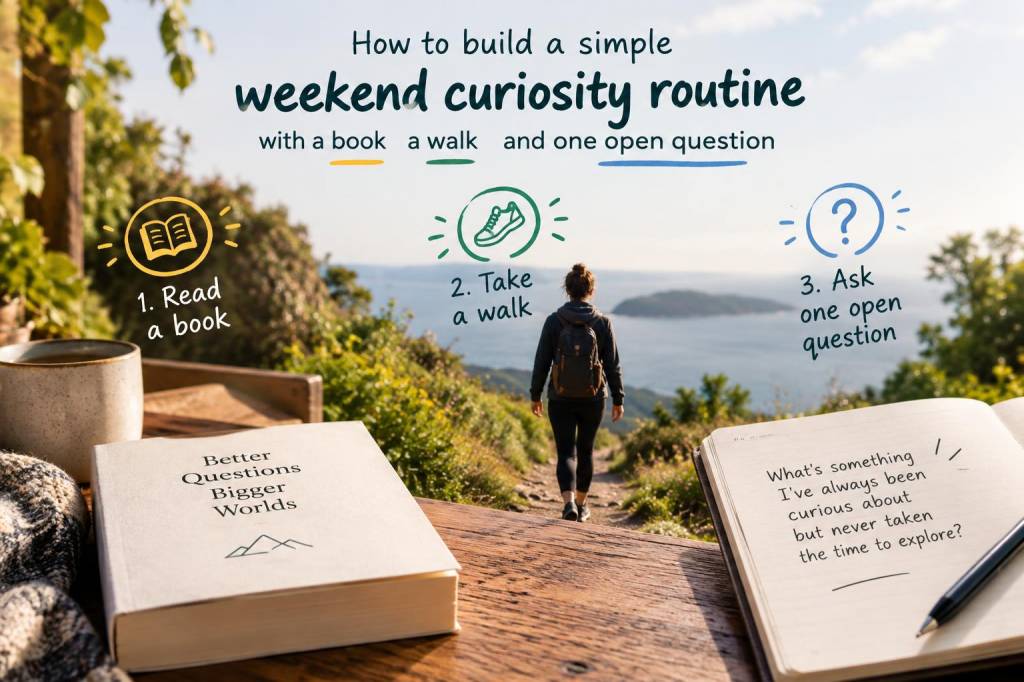
Some weekends feel full before they even begin. Messages pile up, errands creep in, and by Friday evening I can already feel my attention scattering in a dozen directions. When that happens, I like to give myself a small structure that feels gentle rather than demanding: one book, one walk, and one open question. It is simple enough to remember, flexible enough to fit real life, and surprising enough to leave me feeling refreshed instead of drained.
I came to this routine because I wanted something that would help me feel more awake to my own life. I did not want another productivity system, another list of things to optimize, or another weekend that disappeared in low-grade distraction. I wanted a rhythm that would slow me down without making me passive. A book gives me focus. A walk gives me space. A question gives me direction. Put together, they create a kind of curiosity practice that feels both restful and alive.
Why I keep returning to this pattern
What I love about this routine is that it does not ask me to perform. I do not need a perfect morning, special equipment, or a long block of free time. I only need a little willingness to pay attention. Curiosity is easier to access when I remove pressure from it. If I tell myself I must have a brilliant insight, I usually go blank. If I tell myself I only need to notice something interesting, my mind opens.
The book gives me a point of entry. I usually choose something that feels slightly outside my usual habits: essays, nature writing, memoir, or a novel with a strong sense of place. I am not trying to finish it quickly. I am trying to spend time with a voice, an idea, or a feeling that can stretch my perspective. A good book can nudge me toward questions I would not have asked on my own.
The walk gives those questions room to breathe. I notice more when I am moving than when I am sitting at a desk. My thoughts loosen. I hear the texture of the street, the rhythm of my steps, the changing light, the way people carry themselves through their day. Even a short walk can change the shape of my thinking. I often return with a sense that something in me has shifted, even if I cannot name it immediately.
The open question is what turns the whole thing into a curiosity routine rather than just a pleasant reading-and-walking habit. I like questions that feel wide rather than clever. I am not looking for a quiz answer. I am looking for a doorway. A question such as What have I been avoiding noticing? or What is this season asking from me? can stay with me for hours without feeling heavy.
How I choose a book for this kind of weekend
I do not think this routine works best when the book feels like homework. I want it to feel inviting. That does not mean it has to be easy, but it should feel alive in my hands. I often choose a book that I have been meaning to read for a while, especially one that has been waiting on my shelf long enough to gather a little gravity. Sometimes I choose based on mood: if I feel tired, I reach for something lyrical and spacious; if I feel restless, I choose something grounded and observant.
I also pay attention to whether the book gives me a sense of texture. I like writing that notices details, because detail tends to awaken my own attention. A book about travel, food, memory, gardens, cities, or ordinary rituals can be especially useful because it encourages me to notice my own surroundings in a new way. I am not reading for escape alone. I am reading for resonance.
There is also a practical side to this choice. I keep the book visible. I place it on a table where I will see it instead of burying it in a bag or on a shelf. That small decision matters more than it should. If the book is visible, I am more likely to pick it up for ten minutes instead of waiting for the perfect reading moment that never comes.
What my walk usually looks like
I do not treat the walk like exercise during this routine, although movement is part of why it works. I treat it like observation. Some weekends I walk through quiet residential streets. Other times I head toward a park, a river path, a market area, or any route with enough variety to keep my attention gently awake. I like places where something changes as I move: tree cover, building facades, light, sound, the pace of other people.
I usually leave my headphones at home. Nothing against music or podcasts, but for this routine I want my own thoughts to be audible. I want the world to have a chance to enter without competing with someone else’s voice. If I do listen to something, it is only after I have spent a while walking in silence. Silence, for me, is not emptiness. It is a field where ideas can surface.
As I walk, I notice small things that would otherwise disappear: a cracked pavement pattern, a window box with late flowers, the smell of coffee from a corner shop, a dog tugging its owner in an entirely different emotional direction. These details matter because they remind me that attention itself is a way of living more fully. I do not need a dramatic setting to feel curious. I only need to show up with my senses open.
The kind of question that works
The open question is the heart of the practice, and I think its power lies in how lightly it is held. I write one question in a notebook before I leave, or I keep it in mind if I do not want to carry paper. I do not force an answer. I let it accompany me. By the time I return from the walk, I may have a response, a fragment, a memory, or a new angle on the question itself.
Some questions I return to often:
What am I noticing lately that I keep skipping over?
What feels fuller than it did a month ago?
What kind of attention do I want more of?
What am I ready to let be simpler?
What has been quietly trying to get my interest?
I like questions that are reflective without becoming overly serious. Curiosity does not need to be dramatic to be meaningful. In fact, some of my most useful reflections have come from very ordinary prompts. A question can be small and still change the way I move through the day.
A rhythm I can actually keep
One reason I return to this routine is that it works with different amounts of time. If I have a full afternoon, I can linger. If I only have an hour, I can still do it. That flexibility matters because weekends are not always spacious. Some are crowded with commitments, and some arrive with unexpected exhaustion. A routine that depends on ideal conditions will not survive long. A routine that can shrink without losing its spirit has a better chance.
On a short weekend, I may read for twenty minutes, walk for thirty, and spend another ten sitting with the question in a notebook after I get back. On a slower weekend, I may stretch each part out and let the day unfold more gradually. The structure stays the same even when the scale changes. That consistency gives me a sense of steadiness without making me feel boxed in.
I have also learned that timing changes the experience. A morning version feels clean and spacious, almost like opening a window in my mind. An afternoon version feels more reflective, as if I am using daylight to sort through the week. An evening version can be especially rich because the walk often gathers the day’s leftovers: things I meant to think about but did not have time to name. Each version works differently, and I like that.
What I notice after I do it
After this routine, I usually feel less fragmented. My thoughts tend to settle into a more coherent shape. I may not solve anything, but I feel more oriented. That matters to me. I do not need every weekend to produce insight, but I do want my weekends to leave me a little more connected to my own mind and surroundings.
I also notice that I become more generous with my attention afterward. I am more likely to listen carefully in conversation, notice a detail in my home, or pause before reaching for my phone. Curiosity has a spillover effect. When I spend time practicing it intentionally, I carry it into ordinary moments. I start asking better questions not just of my weekend, but of my week.
There is a quiet confidence that comes from keeping a routine like this. Not the loud confidence of achievement, but the steadier confidence of knowing I can create meaning from simple materials. A book, a walk, and one open question do not look like much from the outside. Yet together they remind me that a thoughtful life is often built from small, repeatable acts of attention.
| Part | What I use it for | What it tends to give back |
|---|---|---|
| Book | Focused reading and fresh perspective | New language, new ideas, new questions |
| Walk | Movement and mental space | Clarity, calm, and sensory detail |
| Open question | Reflection without pressure | Insight, direction, and self-awareness |
Ways I keep it feeling fresh
I change small details so the routine never turns rigid. Sometimes I choose a different neighborhood. Sometimes I bring a notebook, and sometimes I trust memory. Sometimes I pick a book that is beautifully written but a little challenging. Sometimes I keep the question practical, and sometimes I make it more spacious. The point is not to repeat the exact same experience every weekend. The point is to keep curiosity active.
I also pay attention to my mood before I begin. If I am overstimulated, I make the reading shorter and the walk slower. If I am under-stimulated, I choose a book with more spark or a route with more movement. If I feel emotionally crowded, I ask a question that creates room instead of pressure. That responsiveness is part of what makes the routine sustainable. It listens back.
Sometimes I end up with a sentence I want to write down. Sometimes I end up with a small memory from childhood. Sometimes I end up with nothing obvious at all, but even then I usually feel more present than I did before I started. For me, that is enough. Curiosity does not always need a visible outcome to be valuable. Sometimes it is enough that it changes the quality of attention for a little while.