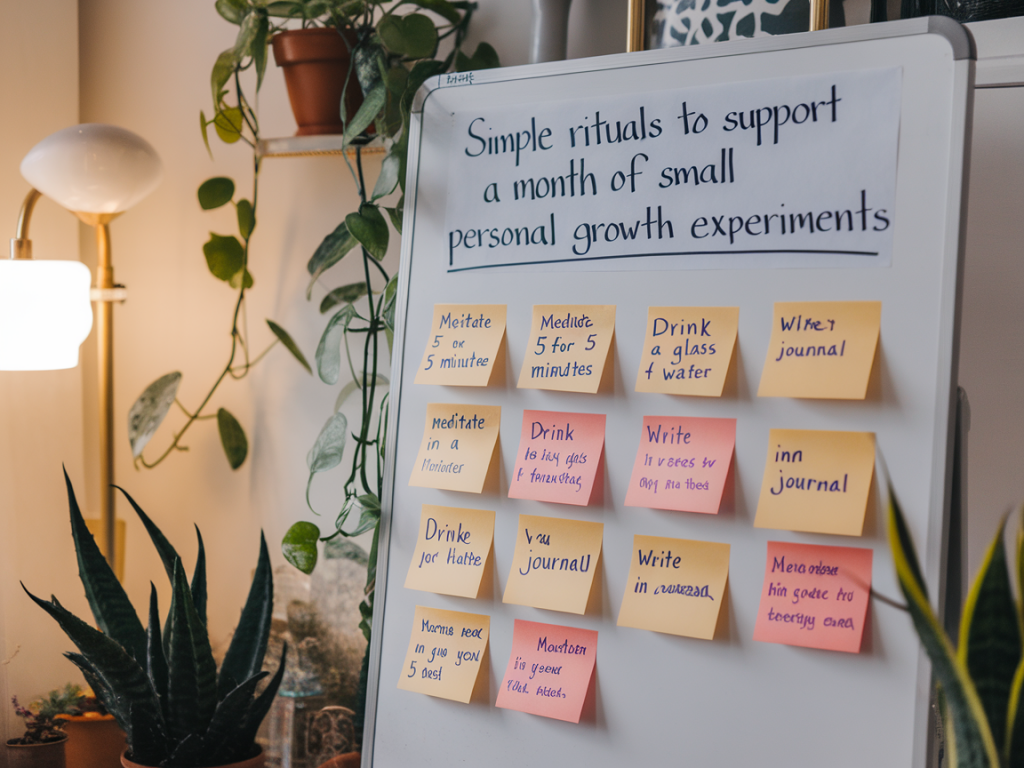
I love the idea of small experiments because they feel doable and curious rather than demanding. A month is long enough to notice patterns and short enough to keep things playful. Over the years I’ve found that pairing a tiny experiment with a few simple rituals—small, repeatable acts that frame the work—makes the whole process smoother and more likely to stick. Below are the rituals I turn to whenever I try a month of personal-growth experiments, along with practical prompts and a sample four-week plan you can adapt.
Why rituals, not resolutions
Resolutions tend to start with a big declaration and quickly rely on willpower. Rituals, by contrast, create scaffolding. They attach a new behaviour to an existing habit, give it a moment of reflection, and make room for curiosity. When I decide to try something new for a month—learning to wake up earlier, trying a micro-writing habit, or experimenting with a 10-minute daily movement practice—I pair it with three core rituals: a ritual to start the day, a ritual to check in, and a ritual to reflect.
Start-of-day ritual: anchor the experiment
My morning ritual is intentionally short and sensory. It tells my brain: "This is an experiment day." Here’s what it looks like most mornings:
- Make one thing—a pot of tea or a small cup of coffee. The act of preparing a drink signals the start of a focused moment.
- Open a notebook—I keep a rebound notebook or a small Moleskine by the kettle. I write the date and one intention for the day in one line. It might be “10 minutes of stretch,” “write 200 words,” or “no social media before lunch.”
- Two deep breaths—slow inhales and exhales to ground myself. It takes 20 seconds but settles the nervous system and reduces resistance.
That three-step ritual is both practical and gentle. The drink helps me wake up, the notebook makes the experiment explicit, and the breaths reduce the pressure that comes with trying something new.
Micro-check-in ritual: reduce friction and stay curious
At midday I do a micro-check-in. This is not a long productivity audit; it’s a moment to notice without judgement. My check-in is usually 60–90 seconds and follows this pattern:
- Look at the notebook entry for the day.
- Mark one word: “done,” “progress,” or “skip.”
- If I’m “skip,” write one sentence about why—tired, busy, didn’t want to, etc.
Writing the reason helps me gather data. If I skip several days and the reason is “too rushed,” that tells me the experiment needs to be adjusted to a smaller time slot or a different trigger.
Evening ritual: small reflection and gratitude
Every evening I spend five minutes reflecting. This is the ritual that turns moments into insights. My routine includes:
- List one win from the experiment today—no matter how small. (“Woke early,” “finished a 5-minute stretch.”)
- Note one observation—what felt odd, what felt good, what I want to change.
- Write one line of gratitude related to the experiment (“grateful for extra quiet before breakfast”).
These short entries compound into a narrative. After a week you can see whether an experiment is helping and why.
Weekly ritual: review, tweak, plan
On Sundays I do a weekly ritual that takes 15–30 minutes. I use a simple layout in my notebook or a Trello board to track three things: what worked, what didn’t, and the next week’s tiny changes. Practical tools I sometimes use are the app Streaks for habit tracking, or a paper habit tracker I draw by hand. The tactile act of checking a box feels satisfying in a different way to tapping a screen.
Ritual to rescue a failing experiment
Not every experiment thrives. When something stalls, I use a “rescue ritual” to troubleshoot: pause, simplify, and reframe. For example, when a daily 20-minute writing habit felt impossible with a toddler at home, I paused the 20-minute target and reframed it as “one paragraph” or “write for 10 minutes total, split into two 5-minute sessions.” Small wins rebuild momentum and confidence.
How I choose month-long experiments
I pick experiments based on curiosity rather than guilt. Here are the questions I ask before committing:
- Will this feel interesting after the first week?
- Can I do a meaningful version of it in 5–10 minutes a day?
- Does it connect to something I already enjoy or do (walking, cooking, journaling)?
Examples I’ve tried: morning pages for 10 minutes, a micro-meditation habit (5 minutes before bed), a lunchtime walk, practicing one new recipe per week, and replacing evening scrolling with a 10-minute sketch. Most stuck because I paired them with the rituals above.
Tools I find useful
I prefer low-friction tools that don’t demand a lot of setup. A few that I return to:
- Notebook—any small A6 or A5 notebook works. I like the Muji softcover notebooks for their simplicity.
- Pen—a reliable gel pen (Pilot G2 is a favourite) so writing feels pleasant.
- Timer—I use my phone’s built-in timer or a simple kitchen timer for split sessions.
- Habit app (optional)—Streaks or Habitica if you like gamified tracking, but I don’t treat apps as necessary.
- Tea—a small, silly thing, but having a “tea signal” helps me mark the start of a ritual.
Sample four-week plan you can borrow
| Week | Focus | Daily ritual | Weekly tweak |
|---|---|---|---|
| Week 1 | Wake 20 minutes earlier | Morning tea + one-sentence intention; 10-minute gentle stretch | Assess energy; change time or reduce to 10 minutes if too hard |
| Week 2 | Micro-writing habit | Morning tea + write one paragraph (5–10 min); midday check-in | If inspiration low, use a prompt list (see below) |
| Week 3 | Lunchtime walk | 15-minute walk; quick note: one observation | Switch route or invite a friend if motivation dips |
| Week 4 | Evening tech-off | 30-minute screen-free window before bed; read or sketch | Replace with audiobook if reading is difficult |
Prompts to keep curiosity alive
If you choose a writing experiment and worry about not knowing what to write, keep this list handy. Use one prompt per day if you want structure:
- A small kindness I noticed today.
- One sentence about a smell that took me back to childhood.
- Something I learned, even if tiny.
- A decision I’m glad I made this week.
- A recipe I want to try and why.
How to know if the experiment is working
Results can be surprising. Often the outcome is less about mastering a skill quickly and more about learning how you respond to making small changes. Look for these signs:
- Less resistance than before—small rituals make the habit feel normal.
- A shift in mood or energy—more calm, clearer focus, or a lighter routine.
- New questions—if an experiment sparks a follow-up idea, that’s progress.
Finally, remember that the goal of a month-long experiment is not perfection. It’s information. The rituals I use help me collect that information in a way that’s kind and useful. If you decide to try a month of small experiments, pick one thing, add one start ritual, one midday check-in, and one evening reflection. Keep it playful and be ready to change one small detail every week. If you want, share what you try—I love hearing the tiny discoveries that make a month feel different.