I used to think the only way to reclaim time from my phone was drastic: delete apps, go cold turkey, or move to the simplest handset I could find. Turns out you can free up meaningful minutes — easily adding up to around two hours a week — without losing any of the apps you love. Over the past year I've experimented with gentle, practical habits that nudge my phone use from reflexive scrolling to something a bit more intentional. Below I share the exact habits I use, why they work, and small ways to make them stick.
Make checking your phone a scheduled habit
One of the biggest time sinks is the endless “just checking” impulse. I reduced that by giving myself explicit pockets for phone time: morning catch-up (20 minutes), a single midday break (15 minutes), and a short evening catch-up (20 minutes). Outside those windows I leave the phone out of reach when possible.
Scheduling checks paradoxically reduces stress — knowing there's a set time to deal with messages and news stops me from feeling like I have to be constantly available. If you prefer a digital nudge, use your calendar or an alarm. I use simple calendar blocks labelled "Phone check" that act like appointments I can't skip.
Trim notifications, not apps
Rather than deleting apps, I turned almost all notifications off. Out of 60+ apps I only allow push alerts for things that really matter: direct calls, messages from immediate family, and calendar reminders. Everything else — social media, shopping, games, newsletters — is silenced.
Try this: open your phone’s notification settings and ask for each app, "Would I be upset if I missed this for an hour?" If the answer is no, turn the notification off. You'll get the same number of notifications in your notification history if you look for them later, but you won't be interrupted while you're making coffee, cooking, or focusing on work.
Design a minimalist home screen
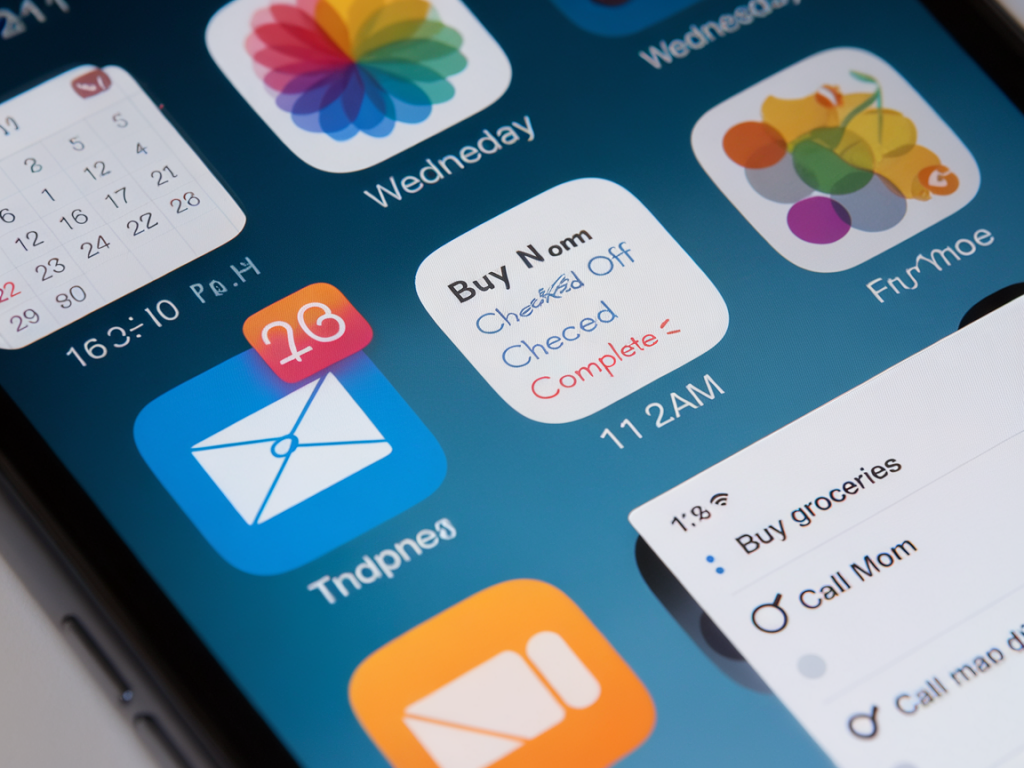
My home screen used to be a buffet of temptations. Now it’s a curated landing page of useful tools: Messages, Calendar, a notes app, a photo camera, and a single folder for apps I use intentionally (banking, maps, a recipe app). Everything else lives several swipes away.
That friction matters. If Instagram is three swipes away rather than one, I don't open it automatically. Even tiny delays break the autopilot.
Batch social media, email and news
Instead of letting email and social media dictate my rhythm, I batch-process them. I check email only during two short periods (morning and late afternoon) and handle social media during my scheduled phone checks. Batching reduces context switching and the time I spend re-orienting after each interruption.
For email, use quick filters: archive or delete anything that’s not an action item. For social media, use lists or close friends features so you see fewer, more meaningful posts rather than a never-ending scroll.
Use Focus modes and Do Not Disturb wisely
Focus modes (iOS) and Do Not Disturb (Android) are my secret weapon. I have a "Deep Work" mode that blocks social apps and conversations but allows calls and calendar alerts. I also have a "Relax" mode that blocks work email in the evenings.
Automate these modes based on location, time, or app usage. Once set up, they save decision-making energy and keep your phone quiet when it matters most.
Turn on grayscale or reduce color
This feels dramatic but it works. Turning my phone to grayscale made apps visually less enticing — I noticed I open them less. You can also reduce color or lower saturation in accessibility settings for a similar effect without making the screen a complete chore.
Create “micro-routines” for common tasks
I built tiny routines for repetitive phone tasks: a quick template reply for "I'll reply later", a note-taking shortcut for grocery items, and voice dictation for hands-free messages. These micro-routines shave seconds off many interactions, and seconds add up.
- Use text replacements: typing "omw" becomes "On my way!"
- Set up email templates for frequent replies
- Use Siri, Google Assistant, or voice typing to draft short messages
Use app timers and gentle limits
Instead of deleting apps, I set app timers (Screen Time on iOS, Digital Wellbeing on Android). I give myself small daily limits — 10–20 minutes for social apps — and when I hit the limit the phone nudges me to confirm that I really want to continue. Most of the time I close the app.
The combination of a timer and occasional friction is kinder than immediate removal and more durable than willpower alone.
Replace passive browsing with small creative tasks
When I feel the urge to scroll, I keep a short list of alternatives in my Notes app: write a 100-word micro-journal, take a 5-minute walk, sketch one idea, or read a single poem. These quick swaps satisfy the urge for downtime but carry more emotional payoff.
Use offline moments intentionally
I schedule small phone-free blocks: morning coffee, cooking, or walking without the phone. These moments build tolerance for being offline and shrink the habit loop that says "I'm bored → grab phone." Keep an e-ink reader or a physical notebook nearby to replace the phone during these pockets.
| Habit | Estimated weekly time saved | Why it works |
|---|---|---|
| Scheduled checks | 30–45 minutes | Reduces constant interruptions and reflexive checking |
| Trim notifications | 20–30 minutes | Stops reactive behaviour; fewer context switches |
| Minimal home screen | 15–25 minutes | Creates friction for distracting apps |
| Batching email/social | 20–30 minutes | Efficient single-tasking vs. frequent checks |
| App timers + Focus modes | 20–30 minutes | Automated limits that reduce overuse |
Small changes you can do right now
- Open notifications settings and silence three apps you don’t need instant alerts from.
- Move your biggest distraction into a folder two swipes away.
- Set a 20-minute "phone check" calendar event for tomorrow morning.
- Create one text replacement or email template you’ll actually use.
- Enable a Focus mode for one work session and automate it for your usual work hours.
The point isn’t to punish yourself or impose rigid rules; it’s to make small, reversible changes that change the environment and your habits. For me, that has added up to roughly two hours a week of reclaimed attention — more time for cooking experiments, a short sketch, or a relaxed walk. If you try one or two of these tweaks, notice how much easier it is to focus and how that little extra time makes the rest of the day feel richer.